
 BG
BG  BY
BY  CY
CY  CZ
CZ  DE
DE  EE
EE  ES
ES  GR
GR  HU
HU  IS
IS  IT
IT  LT
LT  LV
LV  MY
MY  PL
PL  PT
PT  RO
RO  SK
SK  TR
TR  UA
UA  USA
USA Bresser Science TRM-301 Microscope
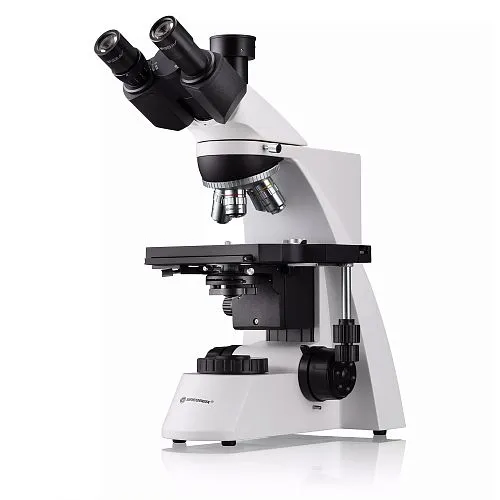
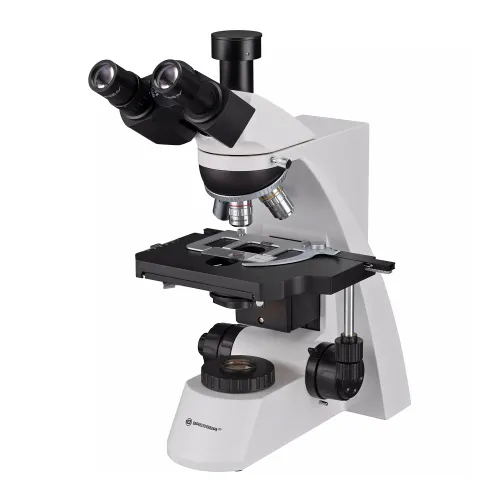
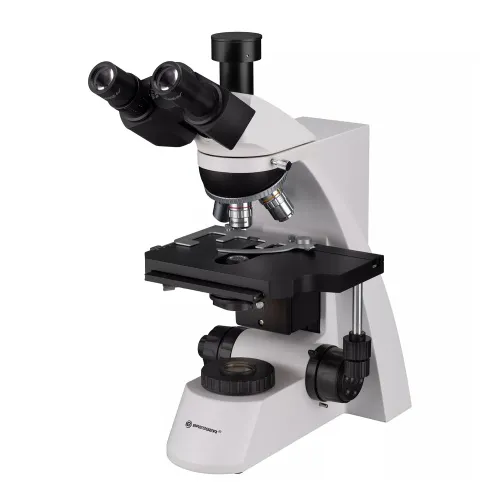
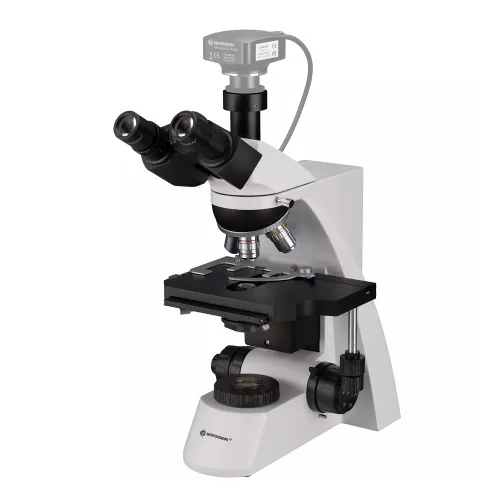
Trinocular head. Magnification: 40x–1000x
| Product ID | 62564 |
| Brand | Bresser GmbH, Germany |
| Warranty | 2 years |
| EAN | 4007922150260 |
| Package size (LxWxH) | 37x30x53 cm |
| Shipping Weight | 10.3 kg |
The Bresser TRM-301 is a trinocular biological microscope of first-class quality: this means excellent imaging, good ergonomy, high stability and a modern attractive design. It is a laboratory microscope, which permits an intensive use, e.g. in medicine, biology, agriculture and industry area. Also, we can recommend it to the engaged hobbyist as his "microscope for a lifetime". A particular important feature of the TRM-301 is its ability for the Köhler illumination. This optimal illumination is bright, cool (going easy on the object), homogenous, reflex free and rich in contrast, so it makes the full use of the microscope optics. The Köhler illumination is standard for scientific research and microphotography. It is achieved with the fixed field diaphragm and the adjustable Abbe condenser (numerical aperture 1.25; with iris diaphragm). Naturally, the TRM-301 has the other features, which are typical for high-quality microscopes: lengthwise and cross moveable stage, ergonomic coaxial focusing knobs (fine focus: 200 µm/full turn), continous dimmer, planachromatic objectives (4x, 10x, 40x, 100x-oil retractable), 10x wide field eyepieces (mounted in 30° inclined eyepiece tubes), adjustment of eye relief, diopter adjustment and the phototube.
Key features:
- Biological microscope
- Type head: trinocular
- Magnification: 40x-1000x
- 2 eyepieces: both WF 10x (23mm)
- 4 objectives: 4x, 10x, 40x, 100x oil
- Type objectives: planachromatic
- Condensor: Abbe N.A. 1.25
- Illumination: 12V/30W halogen with dimmer
The kit includes:
- Microscope
- 2x eyepiece (WF 10x)
- 4x objective (PL4x, PL10x, PL40x, PL100x oil)
- Coxial mechanical stage with Nonius scale
- Immersion oil
- Dust cover
- Power cable
| Product ID | 62564 |
| Brand | Bresser GmbH, Germany |
| Warranty | 2 years |
| EAN | 4007922150260 |
| Package size (LxWxH) | 37x30x53 cm |
| Shipping Weight | 10.3 kg |
| Type | biological, light/optical |
| Microscope head type | trinocular |
| Head inclination angle | 30 ° |
| Magnification, x | 40 — 1000 |
| Eyepieces | 10x |
| Objectives | 4x, 10x, 40x, 100x (planachromat) |
| Revolving nosepiece | for 4 objectives |
| Condenser | Abbe N.A. 1.25 |
| Diaphragm | iris |
| Focus | coarse and fine |
| Illumination | halogen |
| Brightness adjustment | ✓ |
| Power supply | 220–240V |
| Adapter | 100/240V; 12V, 3A |
| Application | laboratory/medical |
| Illumination location | lower |
| Research method | bright field |
| Pouch/case/bag in set | dust cover |
and downloads
We have gathered answers to the most frequently asked questions to help you sort things out
Find out why studying eyes under a microscope is entertaining; how insects’ and arachnids’ eyes differ and what the best way is to observe such an interesting specimen
Read this review to learn how to observe human hair, what different hair looks like under a microscope and what magnification is required for observations
Learn what a numerical aperture is and how to choose a suitable objective lens for your microscope here
Learn what a spider looks like under microscope, when the best time is to take photos of it, how to study it properly at magnification and more interesting facts about observing insects and arachnids
This review for beginner explorers of the micro world introduces you to the optical, illuminating and mechanical parts of a microscope and their functions
Short article about Paramecium caudatum - a microorganism that is interesting to observe through any microscope