
 BG
BG  BY
BY  CY
CY  CZ
CZ  DE
DE  EE
EE  ES
ES  GR
GR  HU
HU  IS
IS  IT
IT  LT
LT  LV
LV  MY
MY  PL
PL  PT
PT  RO
RO  SK
SK  TR
TR  UA
UA  USA
USA Bresser Science ETD 301 Stereo Microscope


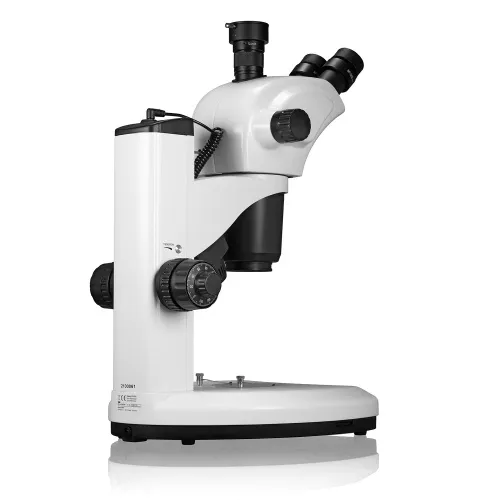



Trinocular head. Magnification: 7x–63x
| Product ID | 78457 |
| Brand | Bresser GmbH, Germany |
| Warranty | 2 years |
| EAN | 4007922071268 |
| Type | stereo/instrumental |
| Microscope head type | trinocular |
The Bresser Science ETD-301 is a stereo incident light and transmitted light microscope with high-quality optics.
It is suitable for use in medicine, agriculture, forestry, forensics, scientific research institutes and schools as well as for the assembly and inspection of small components in precision mechanics and electronics.
The particularly wide base with object table enables the viewing of larger objects. The maximum object height is approx. 85 mm. The large working distance of 100 mm allows working with tools, e.g. for dissecting, measuring or testing.
The instrument has an LED incident light and a transmitted light illumination, which can be used individually or combined and each can be infinitely adjusted. The incident light angle can be adjusted in a particularly user-friendly way. With interchangeable wide-field eyepieces (WF10x) and a 9x stereo zoom lens (0.7x-6.3x), a continuous magnification range from 7x to 63x is realised.
The coarse and fine focusing allows precise focusing, especially at high magnifications and in photography.
The interpupillary distance and dioptric compensation are individually adjustable. The trinocular microscope head can be rotated 360° and has two 45° inclined eyepiece tubes.
The trinocular tube can carry an SLR/system camera (APS-C or DX format) or a c-mount camera (sensor size up to 1") using an optional adapter. By means of a switch, the beam path of one eyepiece is deflected towards the camera. This provides 50% more light than a microscope with a permanent beam splitter.
To connect an SLR or system camera, the adapter and a camera-specific T2 ring are required.
A c-mount camera is connected with the optional adapter.
Key features:
- WF 10x eyepieces with 22 mm field of view (referring to a 1x objective)
- Large, continuous 9x zoom (7x-63x magnification)
- With optional adapter suitable for SLR/system cameras and c-mount cameras
- Tripod with coarse and fine focus
The kit includes:
- Microscope zoom head
- LED microscope stand
- WF 10x eyepieces with 22mm field of view (2 pieces)
- Translucent plastic object plate
- AC adapter (12V 3A)
- Dust cover
| Product ID | 78457 |
| Brand | Bresser GmbH, Germany |
| Warranty | 2 years |
| EAN | 4007922071268 |
| Type | stereo/instrumental |
| Microscope head type | trinocular |
| Head | 360 ° rotatable |
| Head inclination angle | 45 ° |
| Magnification, x | 7 — 63 |
| Eyepiece tube diameter, mm | 30 |
| Working distance, mm | 110 |
| Eyepiece diopter adjustment | ✓ |
| Illumination | LED |
| Brightness adjustment | ✓ |
| User level | experienced users, professionals |
| Application | school/educational, laboratory/medical |
| Illumination location | dual |
| Research method | bright field |
| Pouch/case/bag in set | case |
and downloads
We have gathered answers to the most frequently asked questions to help you sort things out
Find out why studying eyes under a microscope is entertaining; how insects’ and arachnids’ eyes differ and what the best way is to observe such an interesting specimen
Read this review to learn how to observe human hair, what different hair looks like under a microscope and what magnification is required for observations
Learn what a numerical aperture is and how to choose a suitable objective lens for your microscope here
Learn what a spider looks like under microscope, when the best time is to take photos of it, how to study it properly at magnification and more interesting facts about observing insects and arachnids
This review for beginner explorers of the micro world introduces you to the optical, illuminating and mechanical parts of a microscope and their functions
Short article about Paramecium caudatum - a microorganism that is interesting to observe through any microscope